

Bidirectional EV Charging Australia: V2G, V2H & V2L (Explained)
Everything you need to know about using your electric vehicle to power your home, support the grid, or back up your property.
Imagine your car not just draining electricity from the grid but sending power back when your home needs it. Or selling that stored energy back during peak hours when electricity prices spike. That's the promise of bidirectional EV charging and it's happening right now in Australia.
When customers walk into our Energy Solution Centre showroom , one of the most common questions we get these days is: "Can my EV actually power my house?" The short answer is yes, but there's a lot more to it than that.
In this guide, we're diving into everything you need to know about bidirectional EV charging in Australia. We'll break down what V2G, V2H, and V2L actually mean, how these systems work, which chargers and cars are available, and whether this technology makes sense for your situation.


What is Bidirectional EV Charging?
So here's the thing about regular EV charging - it’s a one-way street. Electricity flows from the grid into your car's battery, and that's it. Bidirectional EV charging flips that script entirely. It enables a two-way flow of electricity between your EV and something else, whether that's your home, the electrical grid, or even your camping gear.
Most cars sit parked for around 95% of their life. Bidirectional charging lets you put that battery capacity to work.
There are three main types of bidirectional EV charging:
- V2G (Vehicle-to-Grid): Your EV sends power back to the electrical grid.
- V2H (Vehicle-to-Home): Your EV powers your house directly.
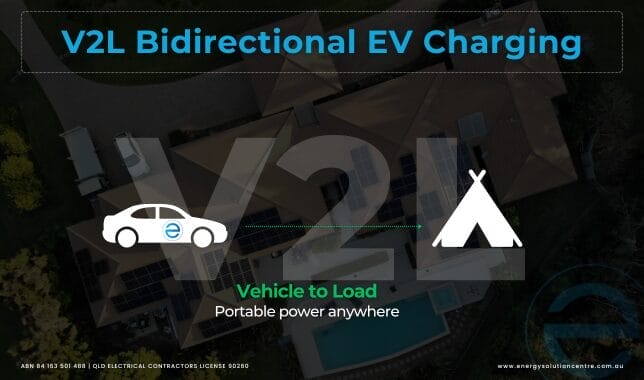
- V2L (Vehicle-to-Load): Your EV powers appliances or devices through an outlet.
Australia now allows bidirectional charging under Australian Standards AS/NZS 4777.2:2020 and AS/NZS 4777.1:2024. These updated standards have removed key barriers, and Australia is projected to have 300,000 V2G-capable EVs by 2030. (Source: ARENA).
Why does this matter for Australian households? Energy bill savings, backup power during outages , and grid support. When you can charge when electricity is cheap and potentially export when it's expensive, you're looking at real savings.
How Does Bidirectional EV Chargers Work?
Alright, let's get into the technical stuff... but don't worry, we'll keep it grounded.
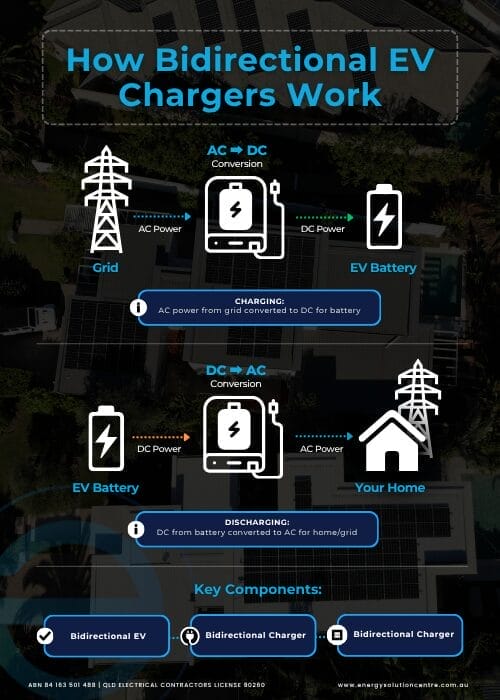
A bidirectional EV charger can push electricity in both directions. When charging your car, it works like any normal charger. But when you want to discharge, the system reverses that process, pulling DC power from your car's battery and converting it back to AC power that your home or the grid can use.
Key components include an EV with bidirectional capability (not every electric vehicle can do this), a bidirectional charger (the box on your wall that manages power flow), and the proper grid or home interface.
Communication protocols like ISO 15118 are crucial. ISO 15118-20 is required for interoperable CCS-based V2G, enabling the car and charger to coordinate when to charge, when to discharge, and how much power to transfer.
From what we've seen with EV charging installations, proper network approval and switchboard assessment are often the most overlooked steps. In Australia, you'll need approval from your distribution network service provider.
There might be requirements for isolation switches, transfer switches for backup power scenarios, and updates to your home's electrical panel. The charger itself is only part of the equation.
Difference Between V2G, V2H, & V2L
Okay, so all three of these are forms of bidirectional charging, but they differ in where that exported electricity actually goes and what you can do with it.
Let's break down each one.
Vehicle to Grid (V2G)
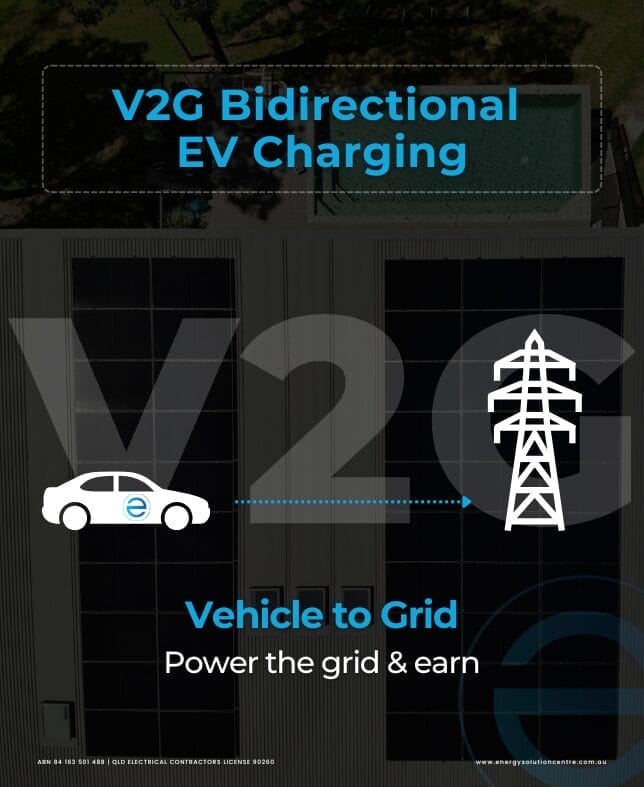
V2G is where your EV supplies power back to the main electrical grid. You charge overnight when electricity is cheap, then during peak afternoon hours, your car exports stored energy back to the grid. In return, you get paid through special tariffs or incentive programs.
By the early 2030s, the storage capacity from bidirectional cars is likely to surpass all other forms of storage in the National Energy Market, including Snowy 2.0. That's massive potential. But V2G is still developing in Australia.
Until recently, bidirectional V2G chargers were only permitted in South Australia and across some applications in WA, NSW, and the ACT for the CHAdeMO charging plug. The regulatory framework is expanding, but you'll need specific approval from your network provider.
Vehicle to Home (V2H)
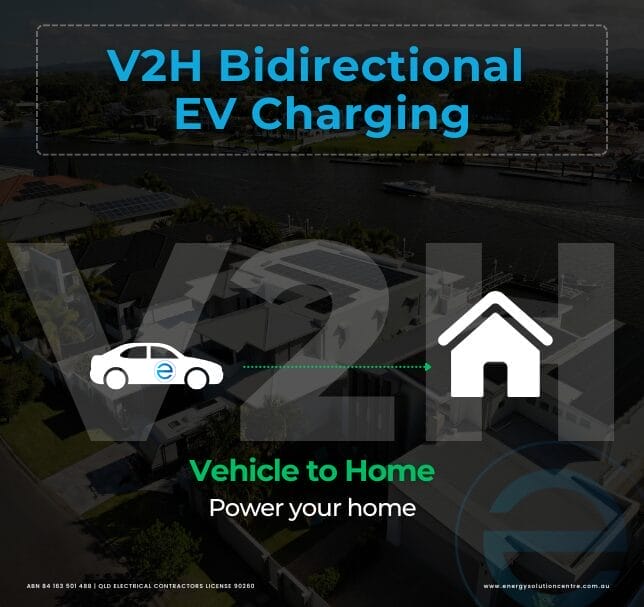
V2H means your EV powers your house directly. Your solar panels generate electricity during the day, which charges your EV. Then in the evening when your solar stops producing, your car supplies electricity to your home instead of drawing from the grid.
We recently helped a family in Burleigh Heads set up their home for V2H capability. They already had a 10kW solar system and were frustrated paying peak rates every evening. Once we explained how their future EV could store that daytime solar and discharge it at night, they were sold on future-proofing their electrical setup now.
For V2H to work in Australia, you'll need a bidirectional charger, potentially modifications to your switchboard, and proper isolation from the grid for backup scenarios.
The benefits are compelling: better self-consumption of your solar energy, resilience during power outages, and reduced electricity bills. The limitations include cost, limited vehicle compatibility, and regulatory approval requirements.
Vehicle to Load (V2L)
V2L is the simplest form and it's actually available right now on many EVs in Australia. Your EV powers appliances or devices directly through an outlet built into the vehicle. You're not connecting to your home's wiring at all.
Think camping with a portable fridge and coffee maker, using power tools at a remote worksite, or keeping devices charged during a road trip. V2L doesn't require any special home installation or network approval. If your EV has V2L capability, you can use it immediately.
CONSIDERING BIDIRECTIONAL EV CHARGING?
Book a free consultation to discuss your home's setup and compatibility. We provide expert solar and EV charging solutions across the Gold Coast .
What Does Bidirectional EV Charging Mean for Australia?
As mentioned earlier, the Australian Renewable Energy Agency projects Australia will have 300,000 V2G-capable EVs by 2030. That's essentially a distributed network of batteries that can help balance electricity supply and demand.
For Australian homeowners with solar, the benefits are clear. Typical feed-in tariffs sit around 5-10 cents per kWh while you pay 25-40 cents to buy electricity back. Storing excess solar in your EV and using it later makes economic sense.
In ideal conditions, V2G could allow EV owners to earn up to $12,000 per year by exporting electricity to the grid, though the Electric Vehicle Council estimates a more modest $2,000 in annual savings.
When we run energy modelling for our customers at Energy Solution Centre, we show them their actual usage patterns from their bills. Most Gold Coast families use 20-30 kWh per day, with peak consumption between 5-9pm. If you've got a 60 kWh EV battery sitting in your garage during those hours, that's essentially 2-3 days of home power just sitting there unused. The potential is huge, but the systems to properly unlock that value are still being built out.
Challenges remain. Each state has its own distribution networks with their own rules about grid export. Standards are being updated, but the approval process can still be complex. Not all vehicles support bidirectional charging, and those that do might need specific firmware updates for the Australian market.
But the future direction looks promising. As more manufacturers release compatible vehicles and charger costs drop, the technology will become more accessible.

Bidirectional EV Chargers Are Now Available in Australia
Bidirectional EV charger options are starting to hit the market. Bidirectional chargers in Australia typically range from $5,000 to over $10,000, excluding installation, with costs expected to drop as more models enter the market in 2025.
One thing we always tell our customers during consultations is that the charger is just one piece of the puzzle. Your home's electrical infrastructure, your network provider's requirements, and your EV's compatibility all need to align. We've had several cases where customers were ready to buy a bidirectional charger, only to discover their switchboard needed upgrades first.
List of Bidirectional EV Chargers (V2G, V2H, V2L)
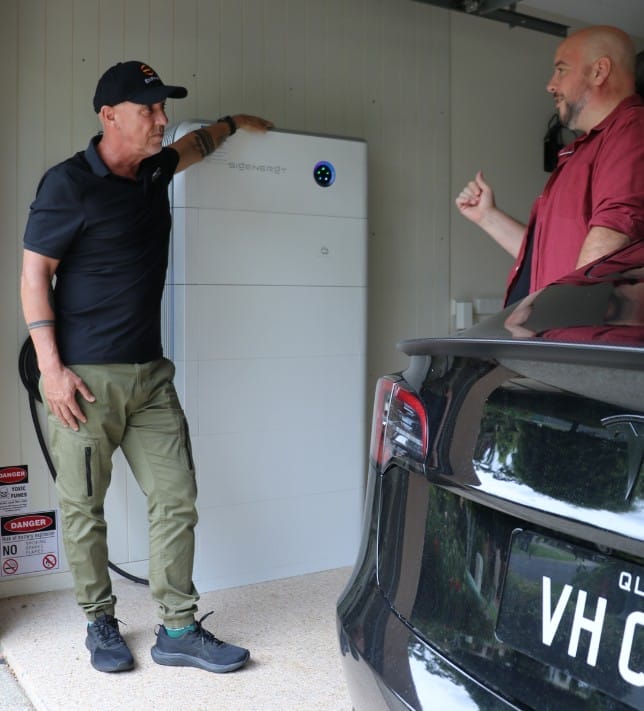
Sigenergy SigenStor
- Type: DC bidirectional charger
- Power: 7 kW and 25 kW models
- Connector: CCS2
- Status: Available now (bidirectional feature via future software update)
- Notes: Tested with vehicles from Tesla, Volvo, Kia, VW, Ford, Hyundai, SAIC MAXUS (LDV), Nissan, and more.
RedEarth / Ambibox
- Type: DC bidirectional charger
- Power: Up to 22 kW
- Connector: CCS2
- Status: Pre-orders starting November 2025, customer deliveries from February 2026, retailing for $9,990 plus GST
- Notes: Australian-made, tested with multiple EV brands including BYD Atto 3, Tesla Model Y, Volvo EX30, and MG4.
V2Grid Numbat
- Power: 7–22 kW residential
- Connector: Both CHAdeMO and CCS2
- Status: Approved by Ausgrid for NSW network connection, pricing expected to start from about $10,000 plus GST
- Notes: Notable for supporting both charging standards.
Wallbox Quasar 2
- Power: Up to 11.5 kW bidirectional
- Connector: CCS2
- Status: Available for pre-order in the US as of March 2025, expected to retail around $10,000 AUD, Australian release date unknown
Evert Power Management Unit
- Power: Up to 22 kW
- Connector: CCS2
- Status: Recently announced for Australia
- Notes: Includes built-in DC charger and inverter, supports over 20 kW of solar PV input with 3 MPPTs, and is VPP-ready.
When choosing a V2G charger or V2H charger, verify it's on the Clean Energy Council's approved list, confirm your EV is compatible, check with your distribution network about export approval, and get quotes from certified installers.
Bidirectional EV Cars in Australia (Tested)
Many modern EVs include V2L capability as a standard feature. However, genuine V2G cars and V2H cars certified for Australia are still limited. The majority of EVs currently sold in Australia have the hardware needed to support DC bidirectional charging, but manufacturers have not yet enabled the capability.
Australia predominantly uses CCS2 connectors. Older V2G technology relied on CHAdeMO charging plugs used by Japanese EVs like the Nissan Leaf, but this standard is being phased out.
V2G Compatible Cars
Currently available V2G-capable vehicles in Australia include:
- Nissan Leaf and Leaf+: CHAdeMO connector
- Mitsubishi Outlander PHEV: CHAdeMO (models from 2017 onwards)
- Mitsubishi Eclipse Cross PHEV: CHAdeMO

Recent testing by RedEarth Energy Storage has demonstrated bidirectional discharge capability with several CCS2 vehicles, though manufacturers have not yet officially confirmed V2G support or updated warranty terms.
One vehicle generating serious interest is the Ford F-150 Lightning. RedEarth successfully tested V2G functionality with a right-hand drive converted F-150 Lightning in Australia, achieving 11 kW discharge rates with their bidirectional charger. While the F-150 Lightning is available through specialist importers who handle Australian Design Rules compliance, official manufacturer support for V2G in Australia is still being confirmed.
Potentially capable CCS2 vehicles being tested include models from BYD, Tesla, Hyundai, Kia, Volvo, VW, and others. However, functionality requires manufacturer approval and software updates.
“
Important note: Even if a vehicle has bidirectional capability overseas, the Australian version might not have it enabled yet. Always check directly with the manufacturer or dealer about V2G support for the specific model year and variant available in Australia.

V2H Compatible Cars
V2H tends to be more accessible than V2G because you're not dealing with grid export regulations, just powering your own home. Many of the same vehicles that support V2G can also do V2H. Testing has successfully demonstrated V2H with the BYD Atto 3, Tesla Model Y, Volvo EX30, and MG4 using ambibox chargers.
V2L Compatible Cars
V2L cars are widely available in Australia right now:
- Hyundai Ioniq 5: up to 3.6 kW
- Hyundai Ioniq 6
- Kia EV6: up to 3.6 kW
- Kia EV9
- BYD Atto 3
- BYD Seal
- Genesis GV60
- Genesis Electrified GV70
- MG ZS EV: recent models
V2L is the easiest form of bidirectional charging to use right now. If your EV has it, you can start using it immediately.
WANT EXPERT ADVICE ON EV CHARGING?
Drop by our showroom in Nerang or check out our EV Charging range. We'll help you find the right fit for your home.
AC vs DC Bidirectional EV Chargers
The fundamental difference comes down to where the conversion between AC and DC happens.
AC Bidirectional Chargers
AC bidirectional chargers work through your EV's onboard charger. The onboard system converts between AC and DC in both directions.
Power levels typically range from 7 kW to 11 kW. They're generally cheaper than DC systems and potentially maintain vehicle warranties better since you're using the manufacturer's onboard charging system. However, they offer slower charging and discharging rates and are limited by your EV's onboard charger capacity.
DC Bidirectional Chargers
DC bidirectional chargers bypass the vehicle's onboard charger and work directly with the battery's DC power. The charger itself handles all conversion.
Power levels can range from 10 kW up to 25 kW or higher. In Australia, it looks likely we will move forward with DC bidirectional chargers as the solution in the immediate future.
They offer much faster power transfer in both directions and aren't limited by onboard charger capacity. However, they're more expensive and require CCS2 DC communication protocols.
Pros and Cons of Bidirectional EV Charging
Let's get real about the advantages and limitations, because like any emerging technology, bidirectional charging isn't perfect for everyone.
Pros
- Energy cost savings: Charge when electricity is cheap and use that power during expensive peak periods. With peak electricity prices hitting 40+ cents per kWh while off-peak is under 20 cents, the savings add up.
- Backup power: Especially with V2H, your EV becomes an enormous backup battery. A typical EV has 60–80 kWh of storage that could run essential home appliances for days.
- Better solar integration: Store excess solar in your car and use it later instead of exporting at low feed-in tariffs.
- Grid support: V2G helps stabilise the grid, supports renewable energy integration, and reduces the need for expensive peaker plants.
- Flexibility with V2L: Portable power for camping, emergencies, or remote work right now.
Cons
- High upfront costs: Bidirectional chargers run from roughly $5,000 to over $10,000 installed. That's substantially more than standard Level 2 chargers at $1,500–$3,000.
- Limited compatibility: Only certain EVs support bidirectional charging, and only certain chargers work with those EVs.
- Regulatory hurdles: Getting approval to export to the grid or set up V2H backup systems involves paperwork and network provider approvals.
- Battery degradation concerns: More charge-discharge cycles increase battery wear, though modern EV batteries are robust. BYD's representatives have stated they do not see battery wear as a significant issue with bidirectional charging.
- Industry experts predict bidirectional charger prices should settle around $6,000–$7,000 within three years and then dip below $5,000 further out.
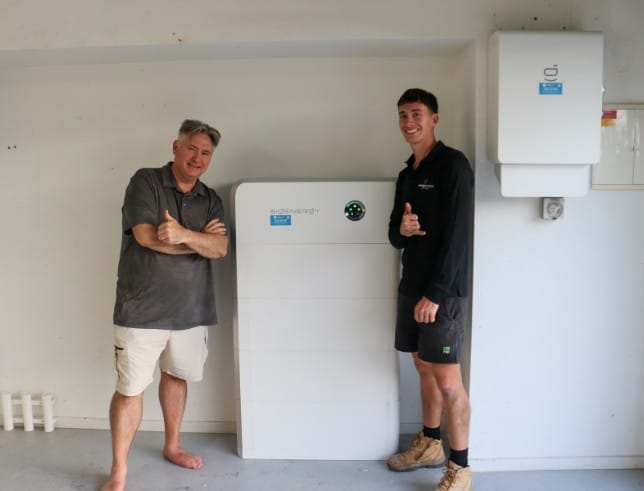
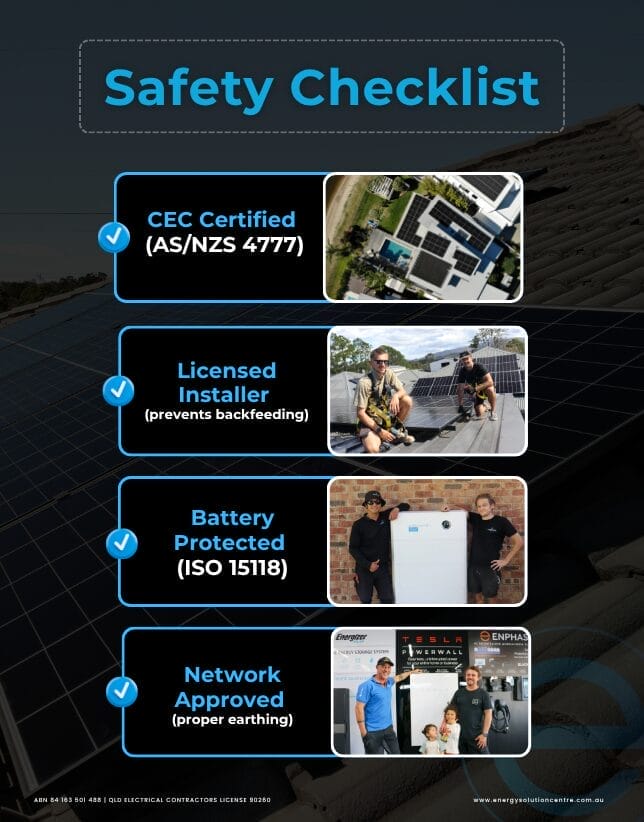
Is Bidirectional EV Charging Safe?
When done properly with certified equipment and professional installation, bidirectional EV charging is safe.
- Charger certification: In Australia, you want your bidirectional charger listed with the Clean Energy Council and compliant with AS/NZS 4777 standards.
- Network approval and installation requirements: Your distribution network has safety requirements. Systems require transfer switches to safely isolate your home from the grid during backup operation, preventing dangerous backfeeding where power from your EV could flow into grid lines.
- Battery safety: Your EV's battery management system has multiple safety protections. Compatible bidirectional chargers communicate through proper protocols like ISO 15118, ensuring the battery isn't overcharged, discharged too deeply, or cycled unsafely.
- Installation by certified professionals: Use a licensed electrician experienced with bidirectional systems. They need to understand safety requirements, relevant standards, and proper earthing and protection systems.
Check with your EV manufacturer whether bidirectional operation is supported and how it affects warranties. Ensure your home insurance covers the system, and keep firmware updated on both your EV and charger.
Your Next Step in Smart EV Charging
Bidirectional EV charging in Australia is at an interesting inflection point. It's no longer theoretical, with real products, real installations, and real benefits. But it's also early enough that hurdles remain.
V2L is widely available now. V2H is possible but requires investment and planning. V2G is still developing but holds enormous future potential. Australia is predicted to have more than two million EVs with bidirectional charging by 2040.
For Australian EV owners and homeowners, the benefits are compelling if your situation aligns: energy cost savings, backup power resilience, better solar utilisation, and environmental advantages.
The limitations are real: high upfront costs, limited compatibility, regulatory complexity, and the need for professional installation. But as more manufacturers release bidirectional-capable EVs and charger costs come down, this technology will become more accessible.
If you're seriously considering bidirectional charging, start by checking your EV's compatibility and understanding what your home's electrical setup can support. For Gold Coast homeowners, we've been navigating these exact challenges with families across the region for years. Our team at Energy Solution Centre stays current with manufacturer updates, regulatory changes, and what's genuinely working in local homes versus what's still just promising technology.
LOOKING FOR EV CHARGING SOLUTIONS ON THE GOLD COAST?
At Energy Solution Centre, we specialise in solar and EV charger installations across the region. Whether you're exploring standard EV chargers now or planning for bidirectional capabilities in the future, our team can help assess your home's readiness and recommend the right setup for your needs. Explore our range of EV chargers or get in touch to discuss your specific requirements.
1300 217 079 | Contact
Frequently Asked Questions
Common questions about bidirectional EV Charging in Australia
Can my electric car really power my house?
+Yes, but it depends on your specific EV model and setup. Many modern EVs have the hardware capability for bidirectional charging, but the feature needs to be enabled by the manufacturer for the Australian market. You'll also need a compatible bidirectional charger and proper electrical infrastructure at home. At Energy Solution Centre, we've helped Gold Coast families set up V2H (Vehicle-to-Home) systems that use their EV to power essential appliances during outages or reduce electricity bills by using stored solar energy in the evening.
Will using bidirectional charging damage my EV battery?
+Modern EV batteries are designed to handle charge-discharge cycles, and manufacturers like BYD have stated they don't see battery wear as a significant issue with bidirectional charging. That said, more cycles do mean more wear over time. Quality bidirectional systems include smart battery management that minimises degradation by respecting charge limits and optimising cycling patterns. Always check with your EV manufacturer about warranty coverage for bidirectional use before you commit.
How long can my EV power my home during a blackout?
+It depends on your EV's battery size and your home's energy consumption. A typical EV has 60–80 kWh of usable battery capacity. Most Gold Coast homes use 20–30 kWh per day, meaning a fully charged EV could theoretically power your home for 2–3 days. In practice, limiting use to essential loads such as the fridge, lights, internet, and some outlets could extend that to nearly a week. One of our customers rode out a multi-day storm outage without even noticing their grid was down.
Do I need three-phase power for bidirectional charging?
+Not necessarily. Single-phase bidirectional chargers (typically 7–11 kW) work fine for most homes and can handle overnight charging plus reasonable discharge rates for home use. Three-phase systems (up to 22–25 kW) offer faster charging and higher discharge capacity, which is beneficial if you want to power your entire home during outages or have high energy consumption. At Energy Solution Centre, we assess your home's electrical setup and usage patterns to recommend what makes sense for your situation.
Can I install a bidirectional charger myself?
+Absolutely not. Bidirectional charging systems must be installed by licensed, CEC-accredited electricians who understand the specific safety requirements. These systems involve complex integration with your home's electrical panel, proper isolation switches, earthing, and grid protection devices. We've inspected DIY attempts that were genuinely dangerous, including one that could have backfed live power into grid lines during a blackout, potentially harming utility workers. At Energy Solution Centre, our in-house installation team handles everything from site assessment to network approvals and final installation across the Gold Coast, ensuring every system meets safety standards and legal requirements. Professional installation isn't just recommended—it's mandatory.
View More of Our Popular Blogs
Want to Learn More?
Let Our Team of Energy Solution Specialists Design Your Dream Home Solar & Battery System
1300 217 079
info@energysolutioncentre.com.au
Get in Touch

menu
Keep in Touch
© Copyright 2024 Energy Solution Centre Pty Ltd All rights reserved - QLD Electrical Contractors License 90260 - ABN 84 163 501 488